Showing posts with label Molecular Biology. Show all posts

Saturday, June 22, 2013

Human Genome Project: Human Genome and Human Gene Therapy

The Human Genome and Human Gene Therapy:

The strategy of human gene therapy is the introduction of DNA into human cells to correct inherited genetic deficiencies.

E.g. Severe Combined Immune Deficiency (SCID). One form of SCID results from genetically inherited defects in gene encoding adenosine Deaminase (ADA), an enzyme involved in nucleotide biosynthesis. Another form of SCID arises from defect in cell surface receptor for Interleukin which triggers differentiation. In both case the progenitor stem cells cannot differentiate into mature immune cells like T and B lymphocytes. Children with this disorder are highly susceptible to bacterial and viral infections.


A gene therapy trial initiated in 1999 was successful in correcting a form of SCID caused by defective cytokine receptors. The researchers introduced the corrected gene for γc cytokine receptor subunit in retrovirus and this was again transfected into CD34+ cells (the stem cells that give rise to immune system cells). The transformed cells were placed back into  the patient’s bone marrow. The corrected gene conferred a growth over untreated cells. A functioning immune system was detected. Although two of patients developed severe form of leukemia due to retrovirus itself got integrated itself into a chromosome of stem cells resulting in abnormally high expression of hematopoietic oncogene that led to uncontrolled cell growth.

The first human gene therapy trial was carried out at National Institute of Health in Bethesda, Maryland in 1990. The patient was a four year old girl crippled by ADA deficiency. Bone marrow cells from the child were transformed with an engineered retrovirus containing a functional, ADA gene. The transformed cells in vivo were introduced into the patient’s marrow. Four years later, the child was leading a normal life.

Although the  gene  therapy is absolute  care it is associated with various risks. One major impediment proved to be the inefficiency of introducing new genes into cells. Transformation failed in many cells, and the number of transformed cells often proved insufficient to reverse the disorder.

Human gene therapy is not limited to genetic diseases. Cancer cells are being targeted by delivering genes for proteins that might destroy the cell or restore the normal cell division. Immune system cells associated with tumors can be genetically modified to produce tumor necrosis factor (TNF). When these lymphocytes are taken from a cancer patient, modified, and reintroduced, the engineered cells target the tumor, and the TNF they produce causes tumor shrinkage. AIDS may also be treatable with gene therapy; DNA that encodes an RNA molecule complementary to a viral HIV mRNA could be introduced into immune system cells (the targets of HIV). The RNA transcribed from the introduced DNA would pair with the HIV mRNA, preventing its translation and interfering with the virus's life cycle.

Human Genome Project:

Discussion in mid 1980 led to initiation of the Human Genome Project in 1989 but the actual work of sequencing began at 1990. Researchers team first generated a detailed physical map of human genome with clones derived from each chromosome.
Fig: The Human genome project strategy: Sequenced by shotgun sequencing.
Human genome project was completed in 2001 and published in April 2003. We have only 25, 000 – 30, 000 genes and 3.9 X 10⁹ bp per haploid genome i.e. 23 chromosomes. 1.1 to 1.4% of our DNA actually encodes proteins. More than 50% of our genome consist of short repeated sequences the vast majority of which about 45% come from transposons. The human genome

can encode 30,000 to 40,000 proteins. There are more than 3 million SNPs. Whole genome contains 10% of Alu elements and present in GC rich region. This project was handled by international collaboration involving groups from the USA, UK, Japan, France, Germany and china known as International Human Genome Sequencing Consortium (IHGSC).

The human and chimpanzee genome differ by only 1.2% at the level of base pairs and even less in gene encoding proteins. This creates 35 million base pair changes.

The overall approach, referred to as hierarchical shotgun sequencing, consisted of fragmenting the entire genome into pieces of approximately 100–200 kb and inserting them into bacterial artificial chromosomes (BACs). The BACs were then positioned on individual chromosomes by looking for marker sequences known as sequence-tagged sites STSs), whose locations had been already determined. STSs are short (usually < 500 bp), unique genomic loci for which a PCR assay is available. Clones of the BACs were then broken into small fragments (shotgunning). Each fragment was then sequenced,  and computer algorithms were used that recognized matching sequence information from overlapping fragments to piece together the complete sequence.

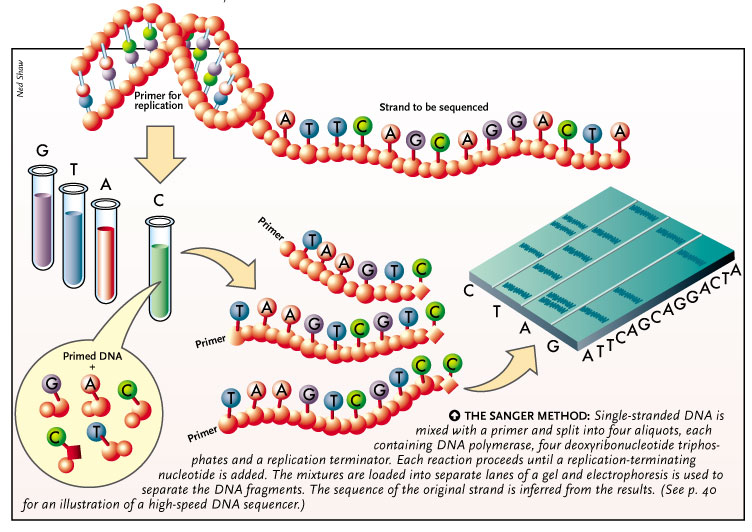
On the basis of STS, PCR based sequencing was done using primers that recognize the vector terminal sequence and using labeled dNTPs. ddNTP was used to terminate the chain elongation process to generate short fragments formed due to addition of ddNTP in the complementary site. These fragments were then sequences and assembled to determine the overlapping bases on the basis of these overlap fragments from entire genome fragments were joined to produce final sequence.

For More information on Human Genome Project, Visit:

(Source: Lehninger's Textbook of Biochemistry)

Transgenic Animals and DNA Micro-array

Transgenic animals:
The strategy here is injection of genes in fertilized mouse ovum, these genes will be incorporated into the genome and found in both somatic and germ cells. By this strategy many transgenic animals have been established and are studied for tissue specific effect on gene expression and effects of overproduction of gene products. The transgenic approach has been used to correct a genetic deficiency in mice. Fertilized ova obtained from mice with genetic hypogonadism were injected with DNA containing the coding sequence for the gonadotropin- releasing hormone (GnRH) precursor protein. This gene was expressed and regulated normally in the hypothalamus of certain number of mice, and these animals were in all respects normal.

Application of Restriction Fragment Length Polymorphism (RFLP)


DNA-based screening is useful not only in determining if an unborn fetus is affected, but also in detecting carriers of the mutated gene. PKU, like many inborn errors of amino acid metabolism, is inherited as an autosomal recessive trait. Identification of heterozygotes can aid in future family planning.

Another approach of detecting the βs globin mutation is by the use of Allele specific oligonucleotide probe (ASO). If PCR is carried out using such primer then it is called ASO-PCR.

Application of DNA Fingerprinting in molecular analysis of Disease: Hemoglobinopathies

Normal Gene variation:

There is normal variation in DNA sequences, this polymorphism occur approximately once in every 500-1000 nucleotides. There are 3, 300, 000 single nucleotide polymorphisms (SNPs) relative to standard initially sequenced human reference genome. Over 80% of SNPs found in DNA have already been found. Each human differs from the next by about 1 bp in every 1, 000 bp and this is what (snips) makes each individual different. There are genomic deletions and insertions of DNA (ie, copy number variations; CNV) as well as single-base substitutions. These are usually occurring in non coding region of DNA. This heritable polymorphism of DNA structure can be associated with certain diseases.

DNA Fingerprinting

DNA Fingerprinting also called DNA typing or DNA profiling:

DNA fingerprinting is based on sequence polymorphisms, slight sequence differences between individuals, 1 bp in every 1,000 bp, on average. Every individual has some differences. Some of the sequence change affects recognition sites for restriction enzymes, resulting in variation in the size of DNA fragments produced by digestion with a particular restriction enzyme. These variations are restriction fragment length polymorphisms (RFLPs).

Another type of sequence variation, and the one now most commonly in DNA typing involves short tandem repeats (STRs). The detection of RFLPs relies on Southern blotting.

Friday, June 21, 2013

Polymerase Chain reaction

It is a test tube method for rapid DNA amplification. It uses two primers that can attach to 3’ end of each strand by complementary base pairing. Primers are 20-35 nucleotides long.

The basic steps in PCR are:

  1. Denaturation of target DNA to separate two strands by heating at 900C.
  2. Cooling of denatured DNA to 40 – 600C this provides annealing of primers.
  3. Annealing of Primer to flanking 3’ end of both single stranded DNA. First temperature is increased to 2-30C above the Tm which gives greater specificity of binding of primer to complementary site and later it is decreased to 2-30C  below Tm permits  efficient amplification. This is the principle of Touchdown PCR.
  4. Extension of primer in 5’ to 3’ direction by DNA polymerase (dNTPs are added to 3’-OH of primer) in both strands. Carried at 720C.
  5. Denaturation of copied new DNA, and allowed to cyclize from step 1 though 3 to get million of copies of target DNA.

Sequencing of DNA

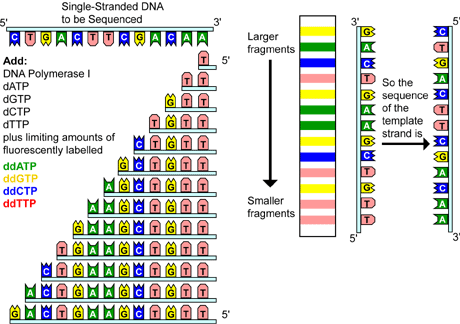
After cloning and amplification of DNA it can be analyzed for its sequence determination. The manual enzymatic method (sanger) can be used where ddNTS are used which can terminate DNA strand synthesis at specific nucleotides as the strand is synthesized on purified template nucleic acid. Here radiolabelled primers are used. One can separate fragments according to size using PAGE. Another method is of Maxam and Gilbert, employs chemical method to cleave the DNA molecules where they contain the specific nucleotides.


Automated DNA sequencing is another approach. Here four different fluorescent labels – one representing each nucleotide are used. Each emits a specific signal upon excitation by laser beam of particular wavelength, which can be recorded by computer. This is the most widely used method.

(Source: Harper's Illustrated Biochemistry)

Thursday, June 20, 2013

Blotting techniques

Visualization of specific DNA, RNA or Protein out of contaminants can be done by blotting techniques like those shown in figure above. These procedure help to determine the number of copies of genes present in the given tissue or whether there are any gross alteration in a gene (deletions, insertions, or rearrangements) because any alteration will change the size which can be resolved by electrophoresis.

Hybridization uses to identify a clone with a particular DNA Segment

Use of hybridization to identify a clone with a particular DNA segment:

Library and Screening of Library.

A collection of different recombinant clones is called library.

Genomic library:

Due to availability of restriction enzymes and cloning vectors the entire genome of organism can be individually packed into a vector. A genomic library is a collection of fragments of total ds-DNA (as obtained by cutting with restriction endonuclease) of a cell line or tissue.

Screening recombinants for inserted DNA fragments

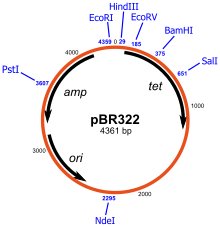
Fig. Plasmid pBR322
Using the plasmid pBR322, a piece of DNA is inserted into PstI site. This insertion disrupts the gene conferring ampicillin resistance to the host bacterium. Hence, the chimeric plasmid will no longer survive when plated on a substrate medium that contains this antibiotic but survives if this is not present. This differential sensitivity to tetracycline and ampicillin can therefore be used to know that the success of recombination. A similar scheme can be used for the identification of DNA insert that can produce peptide which complements the function of deleted form of beta galactosidase gene from vector (DNA insert disrupt the function of this gene). If the insert is successful, it will produce this enzyme which will hydrolyze dye producing blue colonies.

Vectors for cloning

Cloning vectors:

A vector is a molecule of DNA where DNA of interest can be integrated. Essential properties of a vector include: 1) It must be capable of autonomous replication within a host cell; 2) it must contain at least one restriction endonuclease site; 3) it must carry at least one gene that can be used to select the cloned vector, such as an antibiotic resistance gene (selectable markers) Bacterial Plasmids:

Uses of Recombinant DNA Technology

  1. Understanding      molecular      basis      of      disease      like      thalassemia,       familial hypercholesterolemia, cancer, diabetes, etc.
  2. Production of human proteins for therapy e.g. insulin, tissue plasminogen activator, etc.
  3. Production of protein for vaccines e.g. hepatitis B and diagnostic testing e.g. AIDS test.
  4. Predict the risk of disease and monitor pharmacological effects
  5. Use In forensic medicine.
  6. Gene therapy e.g. ADA deficiency, sickle cell disease, etc.
  7. Isolation and manipulation of DNA, including end to end joining of sequence from different sources to make chimeric molecule is the essence of recombinant DNA technology. This involves several techniques and reagents.

Monday, February 11, 2013

Viral RNA extraction: Kit method


RNA extraction by Kit Method:

Here, I am describing the process of viral RNA extraction from QIAamp® Viral RNA extraction kit manufactured by QIAGEN®. There are so many kits available in the market for different purpose. But most of the protocols are somewhat similar in kind. If you know the procedure, you can similarly perform for others too.

Sunday, December 23, 2012

Prokaryotic Transcription: step by step


Initiation:
Begins with the binding of DNA dependent RNAP holoenzyme to promoter in template DNA.

Fig. TATA sequence (Source : Lehninger's Biochemistry, 4th Edition)
There are variations in nucleotide sequences in these promoter sites which provide differential gene expression.

Alpha subunit binds to UP element and sigma factor covers -35 to -10 region.

Binding of RNAP to -35 forms closed complex whereas to -10 region forms open complex, due to the presence of AT region which has low Tm and also these sites have low nucleosomal density.


RNA Metabolism : Basics


RNA METABOLISM

RNA is the only macromolecule having role in storage and transmission of information and in catalysis (ribozyme).

Fig. Classes of Eukaryotic RNA (Source: Harper's Illustrated Biochemistry, 28th Edition)

DNA-Dependent RNA synthesis

Synthesis by RNA Polymerase (RNAP)  that adds NTPs to 3’-OH end using one strand of DNA as template, similar to DNA Polymerase (DNAP). RNA formed is similar to coding strand.

Elongated from 5’ to 3’ end with reading from 3’ to 5’ end on DNA.

Related Posts Plugin for WordPress, Blogger...